
Issue 1 · July 28, 2026
The free AI ride ends this weekend. Your process is still the bottleneck.
Written for the person who actually runs a lower-middle-market business: limited staff, real customers, no AI committee, and about twelve free minutes this week. Only stories from the last ten days or with a deadline this weekend. Sources on everything.
Meta's Business Agent starts charging Friday
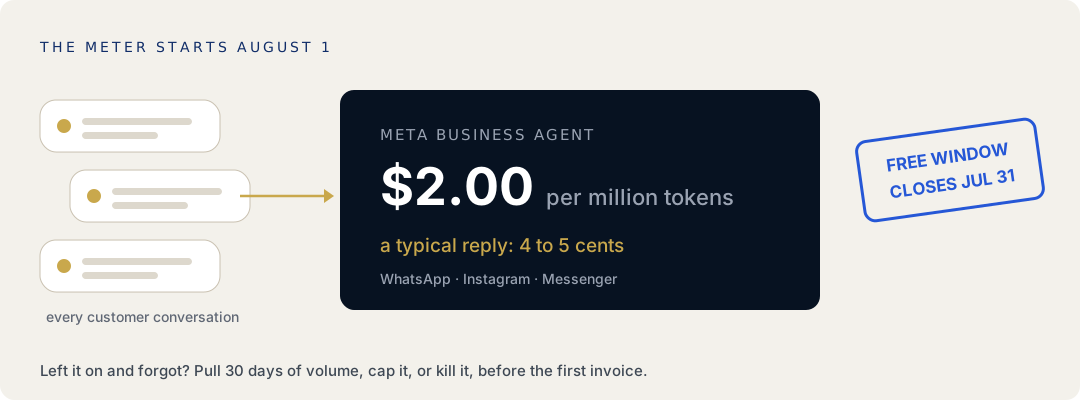
The free test window is over. Starting August 1, Meta bills $2.00 per million tokens for every conversation its Business Agent handles on WhatsApp, Instagram, and Messenger. A typical reply runs 20,000 to 25,000 tokens, roughly 4 to 5 cents. Longer troubleshooting or multi-turn sales chats cost more. And mark the calendar twice: on October 1, Meta also resumes charging for service messages inside the 24-hour customer window.
If you turned the agent on for customer service or booking and forgot about it, this week is your last free look at actual usage. Pull the last 30 days of volume, set a hard monthly cap, or kill it before the first invoice arrives.
Sources: TechTimes, Enterprise DNA.
Claude just made prompting optional
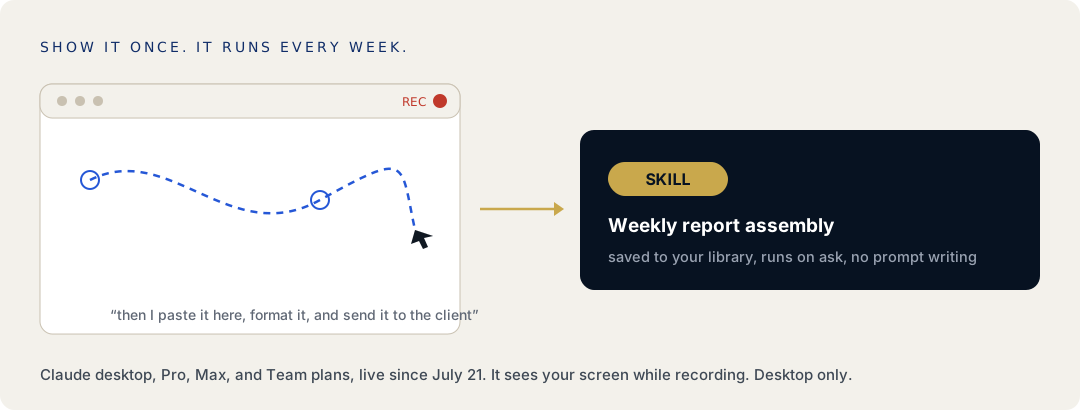
Anthropic's Record a Skill, live since July 21 in the Claude desktop app for Pro, Max, and Team plans, lets you share your screen, do a repetitive task while talking through it out loud, and turns your clicks and narration into a reusable skill. No more writing the perfect prompt. You demonstrate once.
This is the first mainstream feature that watches how you actually work instead of forcing you to describe it. Point it at the one weekly process that still eats two hours: report assembly, file cleanup, invoice routing, the client onboarding checklist. Privacy reality: it sees your screen for that recording session, and it is desktop only for now.
Sources: Dataconomy, Search Engine Journal.
California starts labeling AI content on Saturday
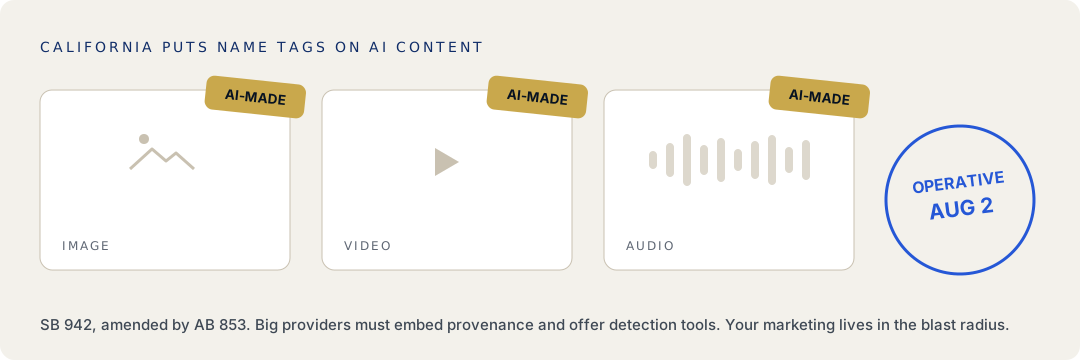
August 2 is the operative date for the California AI Transparency Act, SB 942 as amended by AB 853. Generative AI providers with more than a million monthly users must start embedding provenance data in AI-generated images, video, and audio, offer free detection tools, and give users a visible disclosure option. Platforms pick up additional duties over the next two years.
You are almost certainly not a covered provider. Your marketing content is still in the blast radius: if your product photos, ad creative, or social videos came out of the big tools, platforms will increasingly know, and show it. Two moves before Monday. Inventory every AI-generated asset you have live, and ask the tools you actually use what metadata they embed on your behalf.
Sources: SB 942 text, AB 853 text, Cooley's state AI tracker.
The 95 percent failure rate is mostly about you
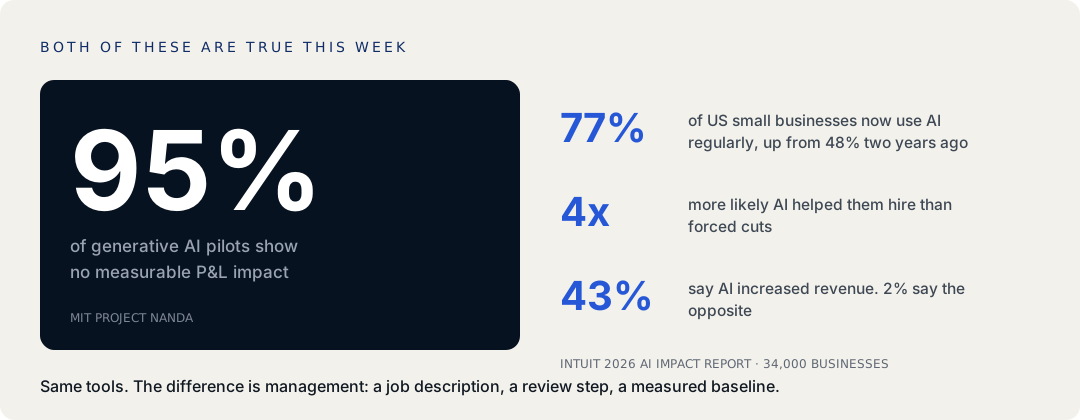
MIT's Project NANDA put a brutal number into circulation: 95 percent of generative AI pilots show no measurable profit-and-loss impact. For a company with no dedicated AI team, that statistic is not abstract. It usually means nobody documented the actual work, nobody set review rules, and nobody measured the baseline hours. The model is rarely the bottleneck. You are.
And yet the optimistic numbers landing this week are just as real. Intuit's 2026 AI Impact Report, built on 34,000 surveyed businesses and anonymized data from over 5 million QuickBooks companies, has 77 percent of US small businesses using AI regularly, up from 48 percent two years ago; businesses using AI were four times more likely to say it helped them hire than forced cuts, and 43 percent say it raised revenue against 2 percent who say the opposite. SBE Council's survey earlier this year found 82 percent of small employers invested in AI, a median of five tools each, and 66 percent reporting revenue gains.
Both sets of numbers are true. The difference is not which model you picked. It is whether you treated AI like a junior employee who needs a job description and a review step, or like magic software.
Sources: MIT NANDA via Fortune, Intuit 2026 AI Impact Report, SBE Council.
The nugget: your AI has amnesia. Use that.
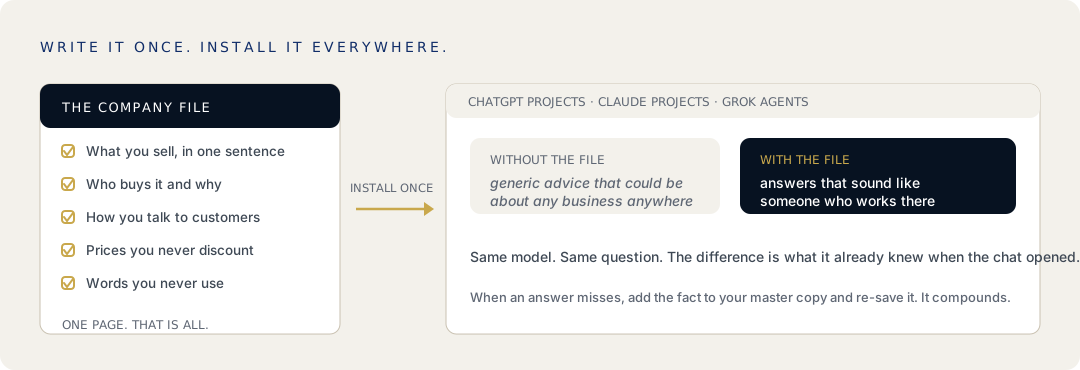
Ever notice the same tool feels brilliant on Monday and useless on Friday? The model did not get worse. Every new chat starts from zero. Nothing you explained last week exists anymore, and the memory features vendors advertise are thin notes, not understanding.
The fix costs five minutes, once. Write a one-page company file: what you sell in one sentence, who buys it and why, how you talk to customers, the prices you never discount, the words you never use. Then do not paste it into chats like it is 2023. Every major tool has a permanent slot for exactly this, and almost nobody running a business has filled it in:
- ChatGPT: Settings, then Personalization, then Custom Instructions for the always-on version. Better: create a Project for your business, upload the file to it, and add it to the project instructions. Every chat inside the project starts already knowing your company.
- Claude: create a Project and upload the file to the project knowledge, then put the essentials in the project instructions. Projects are on every plan, including free.
- Grok: your profile picture, then Settings, then Customize, and create a Custom Agent with the file as its core instructions.
The same model that handed you generic mush will suddenly sound like someone who works there, in every chat, without you repeating a word.
Then keep feeding it. Every time an answer misses because the AI did not know something about your business, add that fact to your master copy and re-save it in each tool. A month from now that single page is the most valuable AI asset your company owns. And when the page starts feeling too small for what your business knows, that is the moment you have outgrown the settings menu.
The model roundup: what to actually use this week
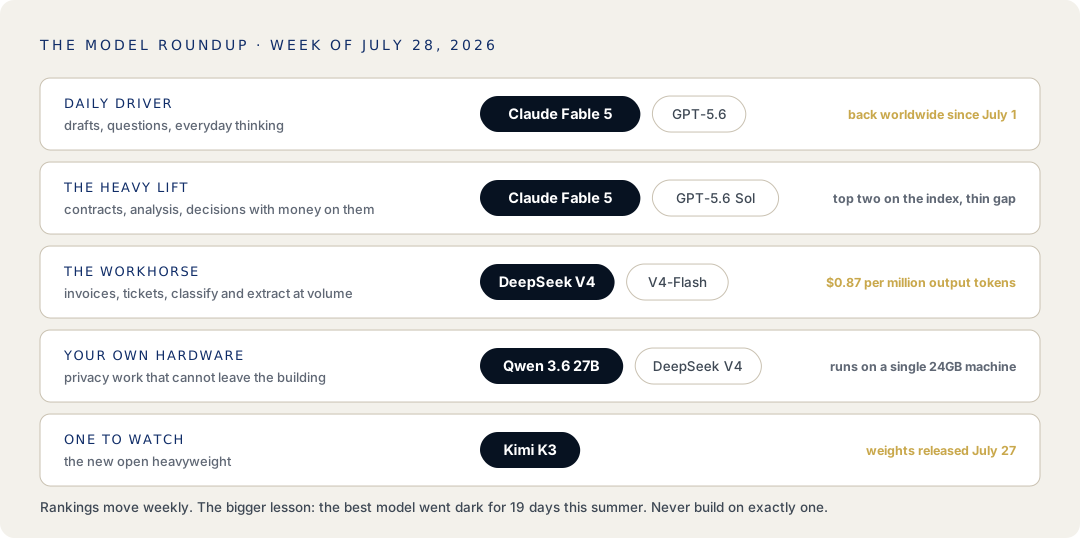
New standing section. Every week we rank the models by the jobs a business actually has, not by benchmark trivia. This week matters more than most: the best model in the world came back from a government-ordered outage, and the best open model ever released just published its weights.
Daily driver and heavy lifting. Claude Fable 5 is back worldwide as of July 1, after US export controls knocked it offline for 19 days over a jailbreak finding. It sits at the top of the independent intelligence index at 59.9, with OpenAI's GPT-5.6 Sol right behind at 58.9. For contracts, analysis, and any decision with real money on it, use the strongest model your subscription includes; the gap between the top two is thin enough that the one your team already pays for is the right answer.
The workhorse. DeepSeek V4 is the price story of the year and almost nobody running a business has noticed. Open weights under MIT, 80.6 percent on the standard coding benchmark, a million tokens of context, and priced at 87 cents per million output tokens, roughly 29 times cheaper than Claude Opus 4.8 for output. Invoice extraction, ticket triage, document summarizing, anything you do ten thousand times a month, should not be running on a frontier model's meter.
On your own hardware. If the work cannot leave the building, Qwen 3.6 27B is the one to know: 77 percent on the coding benchmark, Apache 2.0 license, and it runs on a single machine with a 24GB graphics card. One license note owners skip at their peril: Meta's Llama models carry usage restrictions that can surface in diligence if you ever sell, while Qwen (Apache) and DeepSeek (MIT) do not.
One to watch. Moonshot's Kimi K3 published its weights on July 27, this week. It is a 2.8 trillion parameter model that ranks fourth on the index overall, ahead of Claude Opus 4.8, which makes it the strongest open model ever released. Two honest caveats: reviewers flag a higher hallucination rate on long tasks, and open weights at that size means API access for you and self-hosting for datacenters, not something you run in the back office.
The take. Do not pick a model. Pick a setup that routes: frontier brains for the decisions, workhorse prices for the volume, local models for the private stuff, and the flexibility to swap any of them the week the rankings flip. The 19-day outage was the lesson in miniature: businesses wired to exactly one vendor spent three weeks explaining to their teams why the AI stopped working.
Sources: Anthropic on redeploying Fable 5, VentureBeat, Kimi K3 benchmarks and pricing, Simon Willison on K3, DeepSeek V4 pricing and benchmarks, OpenRouter V4-Pro, open models on consumer hardware.
This week's 30-minute move
- If the Meta agent is live in your business, check volume today or turn it off.
- Write the one-page AI rules: approved tools only, never paste client or employee data into personal accounts, human eyes on anything that leaves the company.
- Record one Claude skill on the process that annoys you every single week.
That is more useful than another seat license.
This weekly is written for owners and operators of small and mid-sized businesses. Vellm installs and manages private AI agents inside operating companies. What they learn is yours, and it compounds. vellm.ai